Showing posts with label Ready mixes. Show all posts

Wednesday, August 16, 2017

Ready To Make - Moar Kuzhambu - Powdered Mix

Sometimes when I travel and my husband has to manage his meals, I try to make it easier for him to fix something, lest he skips his meal. I had tried part cooking and freezing foods which seemed quite handy. Then he found that if I post instructions, that might help him cook a few dishes. Thus, my counter top and refrigerator door would be filled with notes. He had managed very well that he would even grind his batter, make dhal and sambhar.
While I wrote some recipes for my daughter, she still had to juggle time with the demanding coursework and assignments; it was getting harder to cook something elaborate. Soon both of my nephews were also going away from home and were left to manage cooking for themselves.
It was then, my mother tried to coax us to make some ready to cook meals ideas. We had found that making the packaged dosa, upma mixes were easy to make at home. It took us some trials and misses to make them have longer shelf life. Thus, our puliogere ready mix and adai mix took shape. Little more experimenting lead to moar kuzhambu mix and  an 'all - in - one - sambhar mix'. This moar kuzhambu mix is a very quick dish that you cook the vegetable and mix this powder to the whisked curd. Give it a boil and add some tempering. So easy!

Update: (Updated on 7th May 2018)
This powder stays fresh over a year even at room temperature. We had made this batch last year in May and I had carried with me a portion. i just finished my last tablespoon full ready mix powder today.

Ready To Make - Moar Kuzhambu - Powdered Mix

Ingredients:
Makes 5 standard cups of powder
200 ml / heaped 3/4 cup+1 tablespoon fresh grated coconut
125 ml / heaped 1/2 cup raw rice
250 ml / heaped 1 cup / 250grams pack channa dhal / Bengal gram / split chickpeas
250 ml / heaped 1 cup / 250 grams pack thuvar dhal / split pigeon peas
70 ml / heaped 1/4 cup cumin seeds
30 ml/ 2 tablespoons coriander seeds
16 -20 dried green chillis* (1&1/2 inches long and slightly high on heat)
60 ml / level measured 1/4 cup salt
5 ml / 1 teaspoon asafoetida
About 1/3 cup dried curry leaves**

Method:
*To get dry green chillis, wash them, remove the stem and pat them dry. Spread them on a very flat dish / paper / cloth and leave them to dry for a few days. Once they are dry, they become brittle, but the green colour is just about faded. They stay well for over a month and will retain the spice level.

** The curry leaves can be dried after separating them, washed and spread between layers of cloth in the sun. Or you may choose to oven roast dry leaves until they are brittle.

To make the powder, dry roast over a low the coconut until the moisture is gone and the coconut is dry. Do not roast it to turn shade over the white. transfer to a dish and allow to cool.
Then dry roast separately over low - medium heat  the dhals, rice, coriander seeds and cumin seeds until they are just about hot. Take care that they do not over roast. (When grinding for moar kuzhambu normally the ingredients are soaked and ground raw, so we do not over do the roasting here).
Transfer them to another dish.
Finally roast the sea salt until it turns pink and transfer to this dish.
Allow them all to cool.
Pulse all the said ingredients leaving out the coconut until they are a coarse powder, add the coconut and grind further to a powder that is not very fine.


Cool this and store in airtight containers. You may refrigerate this powder if the quantity is more. Usually, the mix stays well for two moths outside of refrigeration.

To make Moar Kuzhambu:
2 tablespoons of above powder
3 - 4 tablespoons thick, slightly sour curd
Vegetable of choice
2 teaspoons ghee /coconut oil for tempering
1/2 teaspoon mustard seeds
Few fresh curry leaves and fresh coriander leaves

Cook the vegetable and keep ready.
Mix the powder to the curd and whisk to blend them. Add another 1/3 cup of water.
Add the cooked vegetable and bring the moar kuzhambu to a boil.
Remove from the stove.

Heat the ghee / coconut oil in a small pan and add the mustard seeds. Allow them to crackle and add the tempering to the moar kuzhambu.

Let the kuzhambu cool down a bit before adding the curry leaves and the coriander leaves.
Enjoy the kuzhambu with steamed white rice or as a side dish for ven pongal.


Wednesday, April 19, 2017

Pudina podi

My parents and grandparents were not in the habit of having breakfast in the true sense. A second dose of filter coffee around 8 A.M. would help them go until their 10 o'clock lunch time. It was not a practice to make breakfast, lunch and dinner everyday. This was a practice for adults and the children were fed rice before school, pack a tiffin box with rice for the noon and ate rice in the night too.
Mostly all the cooking was done in the morning in quantities to suffice for the dinner too, but rice. Rice would be cooked just before dinner for the night, but the sambhar, rasam and other accompaniments would have to make do. Most times there is a shortfall of these and the stock of various podis come handy. It is very likely that there will be a good sized jar with paruppu podi is available in the pantry. Thengai podi does not store for long so it shall be consumed quickly. When in season, mint and coriander are available in abundance, we make thokku, thogaiyal and podis.


Mint is one of those herbs that has high antioxidant properties and has health benefits ranging from oral health, skin care, digestion to prevention of cancer. It is widely used in many cuisines. Mint is used in ice creams, chocolates and in beverages. It is common to find chutney with pudina in many households in India. Typically, we make thogaiyal, chutney and pudina podi with lentils in my home.
This podi stays fresh and flavourful for weeks together at room temperature and since it is dry does not require refrigeration. Give it a try with hot steamed rice and a generous spoon of gingelly oil or ghee.

Pudina Podi
Makes 200 ml in volume


Ingredients:
3 cups packed mint leaves (stalks removed)
1/4 cup urad dhal
1 tablespoon channa dhal
8-10 dry red chillis (adjusted according to heat an d taste)
1/4 teaspoon asafoetida (optional)
2 teaspoons oil to roast the ingredients
Salt as required (I use crystal sea salt and measured 1 &1/4 tablespoons)

Method:
Wash the mint well and pat them dry before separating the leaves from the stalks.
Dry the leaves between two layers of cloth until moisture has dried. Measure the leaves. From a very large bunch of mint, I got 3 cups of leaves.
Heat the oil in a heavy and large pan.
Add the chillis and roast for a couple of minutes.
Add to this the channa dhal and continue to roast.
When the chillis are slightly brittle, add the urad dhal, salt and asafoetida. Roast until both the dhals are golden brown and crunchy.
Put the mint leaves in and keep tossing them around until the leaves are wilted with the heat and turning just about dry.
Cool the mix. transfer to the jar of a dry grinder and grind to a coarse powder.


Transfer the podi to a dish and allow to cool.
Store in clean, tight lid jars to use when required.
Serve with hot rice and oil to mix.
The same can be ground with enough water and be made as thogaiyal.


Saturday, April 11, 2015

(Almost) Instant Puliogere - Ready to Mix Puliogere Spice Powder

I started writing this blog to help my daughter ad her housemates cook for themselves between their hectic time table. If that helped them or not, this activity, has given me much to learn from and experiment and venture further into food. I used to part cook and freeze dishes for my husband when ever I travelled. It helped that he only had to thaw defrost and cook until done. Over the years now, he has picked up cooking for himself a basic meal, and, a little more too.
My nephew found three other guys who would share chores, cooking and washing dishes. He packed a few utensils and basic stuff like home made powders with him. We also purchased ready to mix and cook instant mixes for him. that gave us an idea to try making ready mixes at home. I made adai mix, rawa dosai mix and such last time for my husband which he found useful.
This time on, my younger nephew is off abroad for twelve weeks. He has not been trained to even making his own tea. To manage in a foreign land, between his busy schedule, working on and presenting thesis would be tough. My sister tried finding friends and family closer to his University without much help. Then between my mother and the three of us, we came up with making at home ready mixes that will aid him and the other boy who will be at the same university.. We suggested boil in bag rice to go with whatever we pack. thus we have made rasam, sambhar and this puliogere ready mix. It is not instant, but can be made in under 10 minutes.
The list of ingredients can be intimidatingly long, but the end product is worth the effort.

Ready to Mix Puliogere Spice Powder


Ingredients:
Yield 300 grams of powder (not taking into account the garnish of peanuts, cashews and curry leaves)
(Put together they fill a 800 gram capacity jar)

1 cup (Heaped and tightly packed)/ 250 millilitres/ 140 grams torn bits of tamarind
1/2 cup/ 125 millilitres broken dry red chillis
3 tablespoons sea salt (adjust salt level according to individual taste)
2 teaspoons fenugreek seeds
2 teaspoons turmeric powder
1 teaspoon asafoetida powder
1/8 cup white sesame seeds
1/4 cup coriander seeds
1 tablespoon balck pepper corns
2 tablespoons channa dhal
2 teaspoons urad dhal

For garnish* (See Notes)
1/2 cup/125 millilitres roasted peanuts
25 numbers cashew nuts roasted
10-15 dry red chillis dry roasted and broken in medium size bits
10 sprigs curry leaves, washed and sun dried or roasted dry

*Notes:
These can either be mixed in the powder or can be added in required quantities when the tamarind rice is being mixed.

Method:
Tear the tamarind in small bits removing the membrane and tiny bits of shell that might be present.
Spread it on a plate and dry it in a pre-heated 200 degrees C oven for 8-10 minutes. The tamarind would have become dry and brittle when cooled to room temperature. You may choose to sun dry them for a few days until the texture is achieved.
Keeping the heat low to medium, dry roast each of the listed ingredients separately until crisp. The turmeric powder and asafoetida powder can be dropped in the warm pan after switching the heat off.
Allow to cool and grind to an almost fine powder in a mixer/ spice grinder.
To the mixed powder, add the ingredients for garnish.
Store in an airtight container.
The powder alone comes to 300 grams/ 550 ml. Adding the ingredients listed under 'for garnish' it fills a 800 ml glass jar approximately 420 grams.
This can be stored for six months.


To make the puliogere (puliodharai/ puliamsadham):
Cook a cup of rice, allow to cool and fluff with a fork.
Add two tablespoons of gingelly oil to the rice and mix it in.
To the above add required amount of the powdered ready mix.(If salt is less in the mix, you can always add salt at this stage to the rice also) Mix well with the rice.
Heat some oil in a pan and add mustard seeds, allow them to crackle. Temper the mixed rice.


Serve as part of meal with fried crisps (vadam/ appalam) and/or potato/ banana chips. We enjoyed it with urulai roast.


Saturday, January 19, 2013

Ready to use powdered spices for Araiththu vitta Sambhar

It was by sheer chance that I started making this sambhar powder for storing. The house in Johor had the power supply trip control and when there was heavy lightning and thunder, the supply  to major power appliances will cut. We had to manually set the switch on. So when one goes on a holiday, the  keys were in custody of a friend who would religiously check on the house. That being an impractical option, the other was to empty contents of your refrigerator and the freezers. One friend had an incident of fresh yeast left in the freezer compartment growing out of proportion and spoiling other stuff left in.
We use a lot of coconut in our cooking; but I seem to have extra when I  buy a few more for religious festivals. I scrape them and store in freezer boxes. Thengai podi and thengai thogaiyal are my favourite options to use them up. But given that we are a small family, anything cooked in moderation tends to be excess and we have left overs at times.
During one such holiday, when even friends were all going away for a few weeks, I had some coconut that I wanted to use. Thus I roasted the coconut well and roasted those spices that we usually add to the grinding for sambhar and made the powder. I stored it in a bottle, left it on the counter and went away. It had kept well through my holiday. I used it in the following days, happy with this quick ready to use powder for sambhar. It kept well for weeks outside refrigeration.
I shared this recipe with my mother and aunt who in turn used it too. Now I see to that I keep stock of this powder, when I travel alone and my husband cooks for himself. With limited time to indulge in heavy procedures, he is only too happy to use the powder and some partly cooked and then frozen vegetables I leave for him.
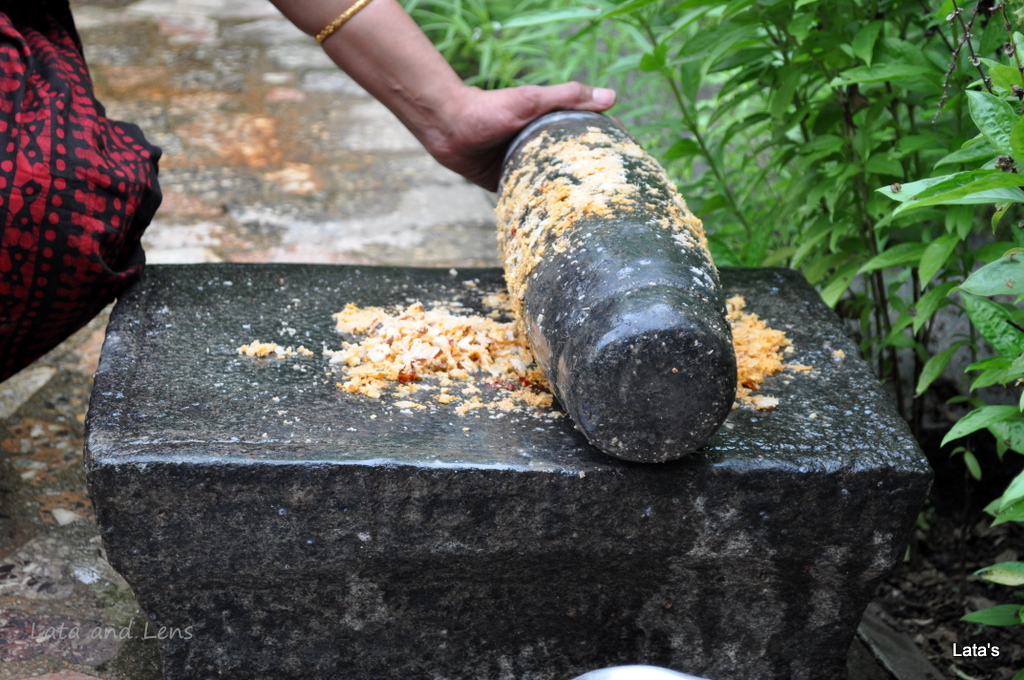
At home, in India, we still use the traditional flat stone and pestle to grind. My mother will not use her small chutney grinder attachment for her grinding unless she is forced to due to weather until few years ago. That was until she had broken her upper arm that has made it difficult for her to apply pressure.


Now we make this powder for her to store and use.

Ingredients:
2 and 1/2 cups scraped coconut
25 dry red chillis (adjust according to heat of the chillis)
1/2 cup coriander seeds
1/3 cup Split Bengal gram
2'' piece dry ginger
1-2 pieces finger turmeric


Method:
Roast each of the above ingredients separately and dry on low to medium heat.
The chillis shall have to become brittle without browning and the coriander and the dhal well done but not charred.
Break the dry ginger and the turmeric in small bits before adding them to the rest of the grinding.
The coconut will have to be roasted until brown and very aromatic.
Allow them to come to room temperature.
While grinding, first run the mixer with the turmeric and ginger pieces to crush them, then add the gram and red chillis.
When they have been just about crushed, add the coriander seeds. Grind these to a coarse powder before adding the coconut.
Pulse with the coconut until just combined and in short bursts lest the coconut oozes oil.
Transfer on to a flat dish and spread to allow the powder to cool.


Store in airtight container and use when cooking sambhar.
I add this powder to my preparation after the tamarind extract has been boiled well with the vegetables and salt and the pressure cooked dhal has been added. The powder is then stirred in and the sambhar is allowed to boil and blend well.
For 500ml of  sambhar, I add 2 tablespoons of the above powder and it serves sufficiently for four people.


Varuththu araiththa sambhar is staple in my home, while I also make this quick sambhar often.
This powder stores well for quite a while, but as it ages, you may feel the smell of coconut oil strongly in the sambhar.
Though it tastes excellent to have freshly ground spice mix in traditional dishes, such powders and ready to mix basics come handy and makes it easy to get cooking done quickly.

Friday, December 2, 2011

Jeeraga rasam ready mix powder


There are quite a few Indian dishes that can be made in preserves and stored. Lately the trend of ready to eat meals has caught up and I see so many varieties of food in small cartons stocked up in the local Indian store aisles. Though I might like to keep some of them handy for a lazy day, I am also apprehensive as they use lot more oil than we normally would and sometimes preservatives.

So when I have to travel and my husband has to cook for himself, I prepare a few stuff at home and he makes a quick meal using these almost ready to eat mixes. For want of time he prefers to keep these stuff to make his job easier.
Not only me, but my sister's mother-in-law who travels every alternate year to stay with her other son prepares much more stuff for my sister before she leaves. It is easy for my sister to manage home alongside her work with some stored quick meal options readily available.

The jeeraga rasam is a quick idea rasam as it does not need the dhal to be pressure cooked. Making the jeeraga rasam fresh at home? Follow this recipe. However, if you think you would like to store some powder and mix it in a quick rasam, try the following.

My aunt (sister's mother-in-law), powders only the dhal, chillis, salt , cumin and other condiments. Her powder requires to prepare the tamarind extract fresh. But I have taken it a step further. I have powdered the mix along with tamarind and hence it is just 'mix with water, bring it to a boil and add tempering and you are ready to serve' recipe.

Ingredients:
150 grams (1X 175 ml cup) thoor dhal
60 grams (2/3rds of the 175 ml cup) cumin seeds
10 to 12 dry red chillis (they weighed less than 5 grams)
2 tablespoons sea salt ( I use salt crystals; if you want to use table salt, adjust accordingly)
50 grams (1/2 of the 175 ml cup loosely packed) tamarind
2 teaspoons turmeric powder
2 teaspoons asafoetida powder

Dry roast the dhal until just about warm. transfer to a flat dish and allow to cool.
Dry roast red chillis until they are brittle and then add to the same the cumin seeds. Toss them around for about two minutes. Transfer to the same dish as the dhal.
Likewise, dry roast the asafoetida powder, salt and the turmeric powder just a little bit.
Clean the tamarind and tear it in pieces. If possible dry the tamrind in hot sun or dry roast gently on a low flame. This exercise is to ensure that the tamarind is dry enough and the powder is uniform without clogging in lumps and removing the moisture.
Take the dhal and condiments in the dry spice blender and pulse. Add to this the tamarind and grind to a fine to slightly coarse powder.
Cool and store in airtight containers.

To make the rasam, mix a 2 table spoons of this powder in two and half cup hot water.
Pour the mixed solution in a pan and bring to a boil, stirring off and on to avoid formation of lumps as the dhal cooks.


Switch the heat off soon as the rasam foams.
Heat a teaspoon ghee in a pan and add mustard seeds. When they crackle add the curry leaves and transfer the tempering to the prepared rasam.
Garnish with fresh chopped coriander leaves if you have them on hand.


This rasam will be rare in density and can be had as soup also.
Enjoy with steamed hot rice and any vegetable of choice.
This powder and some other ready mix powders have been stocked now in my pantry for my husband as he will fend for himself for about twenty days when he leaves ahead of me from our holiday in the US of America.
We will be leaving shortly and spend most part of December with my daughter.
See you all when I get back to routine in January 2012!

Saturday, November 26, 2011

Karuveppilai kuzhambu ready mix powder


I usually make a few 'almost ready to eat' type of dishes for my husband whenever I travel. He finds it hard to eat out every meal. Earlier he may not have wanted to cook for himself, but lately he is happy to have rice with a simple rasam or upma and such. My refrigerator door will be filled with 'post it strips- instructions' for him. I partly cook some dishes and freeze in individual packs like stuffed parathas, roast the vermicelli, onions and microwave the vegetables and so on.

Likewise my mother and one of my aunts have lot more 'pack and carry to wherever you live' ideas for us. For instance, I find it hard to buy fresh curry leaves off the grocer sometimes. My mother's garden has an abundant supply that people in our street just walk in and take bunches for their needs.

Amma would pluck them, clean and dry in shade for me to pack with my other groceries. I store that in bottles and use them. Though this might not match the taste of fresh leaves' they are good enough. The Egyptians will store mint in a similar fashion. Hence my pantry stocks up such leaves too, and my deep freezer will always have a supply of few cut and boiled vegetables for emergencies.

When my daughter started her own cooking in the university, along with rasam powder, paruppu podi etc., my sister's mother-in-law prepared this kuzhambu podi also. It is so easy to make karuveppilai kuzhambu with this powder; just mix in warm water and bring to a boil with some oil added in the start of the process and the kuzhambu is ready to eat.

That recipe is what I am sharing here. The regular recipe for making karuveppilai kuzhambu with fresh curry leaves and spices can be read in an earlier post.

This makes about 200 ml powder which might last a while for you only need two teaspoons for one cup (200ml) of water which will boil and reduce to about 170ml kuzhambu.

Ingredients:
2 cups Fresh curry leaves
100 -120 grams Urad dhal
50 grams Thoor dhal
15 Dry red chillis
1 tablespoon Black pepper corns
2 teaspoons Cumin seeds
1 big lemon size ball of Tamarind
3 teaspoons Sea salt (if using table salt, adjust accordingly)
1 teaspoon Asafoetida powder
1 teaspoon Turmeric powder
1 tablespoon powdered Jaggery
2 teaspoons Oil

Method:
Dry roast separately the two dhals until golden in colour and an aroma wafts from the roasting.
In the hot pan add the salt and roast it until very warm. Tear the tamarind in small bits and toss it n the same pan with the salt for about 5-7 minutes.
Heat the oil and roast the red chillis, pepper and cumin.
Remove these and add to the roasted dhals and the other roasted ingredients.
On a low flame, toss the curry leaves until they wilt and become brittle.
Allow all the roasted ingredients to cool.
Transfer the ingredients, saving the curry leaves and the jaggery to the bowl of the spice grinder and pulse until they are coarsely powdered.
Add the curry leaves and grind further until a fine powder is achieved.
Finally mix the jaggery in this.
Cool well and store in clean glass jars.


To prepare kuzhambu:
In one cup of very warm water dissolve two teaspoons of the powder and mix well without lumps.
Heat 2 tablespoons of gingely oil in a pan. Add some mustard seeds and allow to crackle.


Pour the above mix and cook until the mixture boils and simmer for a further few minutes.
Serve with hot steamed rice, dosais or arisi upma kohukkattai and paruppu adai.

I made this now because I am on a longer holiday with my daughter and my husband gets back to work in order to accommodate his colleagues who are heading home for Christmas.

Wednesday, September 29, 2010

Tomato thokku


One vendor in the greens market here makes me wonder if she keeps the weighing scale for just having one.

She would weigh a kilo of tomato and load my bag. Later at home I would weigh the same and the ointer in my scale will wildly ride well over a kilo. So I end up making tomato soup and juice often. Making pickles and thokkus with tomato are a good idea if we are able to consume them. My husband does not take any pickle. I try not to keep left overs and end up eating my curd rice with the vegetable or the sambhar. So pickles, if made live in the bottles I have stored them for a long time in my home.

But sometimes the urge to make a thokku or pulikkachchal with tomatoes gets me and I make them too. Sometime ago I bought tomatoes just for making the spicy tomato jam which I tried with the recipe from Aparna. I used part of them in the jam and the rest I made the thokku. We kept it for over a week or so and had it with chappathis, dosais and idlis. I have mixed it in rice and relished the same.
It is a common recipe that many of us keep cooking from time to time. But it is indeed one simply delicious thokku.

Ingredients:

12 medium tomatoes (700 grams or little more)
1 small lemon size tamarind, soaked in little warm water.
12-15 dry red chillis (adjust to taste and spice level of chillis). Soak along with tamarind.
1 teaspoon fenugreek seeds lightly roasted and powdered
2 teaspoons mustard seeds roasted and powdered
1/2 teaspoon asafoetida powder
1/2 teaspoon turmeric powder
Salt to taste
1 big ladle full (about 1/3 rd of a cup) Gingelly oil

Tempering:
1 tablespoon oil (from the above)
2 teaspoons mustard seeds
2 teaspoons, channa dhal
2 teaspoons urad dhal
about five full sprigs of curry leaves


Chop tomatoes and grind with the soaked tamarind, chilli mix to a semi thick pulp.
Mix the salt.
Heat oil for tempering in a heavy pan and add the mustard seeds. Once they crackle, add the channa dhal and a few seconds later the urad dhal. Add the curry leaves and pour the pulp in the pan.Add the turmeric powder and asafoetida powder.
On medium heat allow the pulp to reduce and thicken. Add the oil in instalments while stirring in order that the cooking mass does not scorch.
Cook well until raw taste subsides and the oil surfaces above the mass. Add the fenugreek powder and the mustard powder. Mix well and switch off the fire.
Allow to cool and store in bottles.
This thokku stays well for about six weeks provided it is stored well and handled carefully.

Tuesday, June 22, 2010

Pearl onions Thokku


Thokku is one form of pickle I relish. Not inclined to pickles, I make do with the vegetable on my menu or the different kuzhambus to go with my curd rice. But thokkus are exceptions. The other pickles I might have are vadu mangai, moar nellikkai and elumichangai.
If that is me, my husband, I wonder has ever tasted pickles. On the contrary, Niki likes pickles and she also loves the thokkus as much as me. So I make very small quantities, that may last just about a week. However, recently I bought the bag of pearl onions and they were so good that I wanted to preserve them in pickle form.
I made with about 200 grams of pearl onions and hoped that I may pass that off as side dish for dosais. But my apprehension was unfounded. My husband liked the thokku and I have some more reserved in the bottle for the next dosai session.

Incidentally Priya is hosting Siri's Healing Foods representing Onions this month. I am sending her this entry.
Ingredients:
Pearl onions 200 grams
Tamarind a small lemon size ball (make tiny bits of this)
Dry red chillis 7 pieces (medium spice)
Salt as required
Sesame seeds oil/ gingelly oil 1/3 cup

Tempering:
1 teaspoon mustard seeds
Few curry leaves
2 tablespoons urad dhal
1 teaspoon Asafoetida powder

Peel the pearl onions and cut them roughly, just to facilitate the grinding in the mixie.
Take one tablespoon oil in a heavy pan. When the oil is hot, saute the pearl onions, tamarind, salt and the red chillis until the onions are soft.
Allow to cool. Transfer the mix to the jar of a mixer-grinder and coarsely grind it.


Heat the rest of the oil in the same heavy pan. Add the tempering. When the mustard seeds crackle and the urad dhal is golden, transfer the onion mix to the pan.
Cook this on medium heat until the blend is well done and the oil surfaces.

It should be well cooked in order to enhance shelf life. This is a preserve that can stay at room temperature for about a fortnight. Can be refridgerated also if desired.
This makes an excellent side dish for dosais and chappatis. You may even mix with hot rice.
We had this with rawa dosais this weekend!

Thursday, September 3, 2009

A Sunday Lunch Menu


A colleague of my husband wanted to get together for lunch. He stays alone here and cooks his dinner while managing on cornflakes and toasts in the morning. The Port canteen supplies him whatever vegetarian they can come up with for lunch. So this friend wanted homecooked but insisted on potluck. However, most percentage of potluck was what I've showcased here.
My menu for that Sunday afternoon was
Steamed rice, raayathugal (pachchidi variety), thalivadaam, dhania podi, ennai kathrikkai kuzhambu, mysore rasam, microwave mango chutney and avaraikkai paruppu usili. He took care of one more vegetable and the dessert.
The thalivadaam was sent to me by my sister's mother-in-law. Recipes for the rest of the menu are what I'm writing for you and posting to RAKS Kitchen's ongoing event. Cooking for Guests.
Raayathugal: ( Fancy name for a very delectable thayir pachchidi in my cookbook by Ku.Pa. Sethu Ammal)
Ingredients:
6"long snake gourd piece /12 pieces okras /15 pieces cluster beans
Either of the three vegeatables -(ensure these are fresh and tender).( I've used snake gourd)
1/4 cup Curd -ensure that it is not very sour
2 pieces Green chillies
Ghee/oil for tempering
1/2 teaspoon mustard seeds
Curry leaves 1 sprig
Salt to taste.
Cut the desired vegetable into very tiny pieces. Chop the green chillies.
Heat ghee/oil in a kadai, temper the mustard seeds and curry leaves. Add the chopped chillies and vegetables and cook in the ghee/ oil until soft. If the vegetables are tender you will not require any water to cook. Sprinkle some water if necessary and cook covered if the vegetables are not very tender. Add the salt and cook further.
Remove from heat. Allow to cool and add the curd and mix well.
Serve as side accompaniment with a meal.
Dhania podi:
Podis and thogaiyals are staple in my family. I make and store them. On last count I have stock of paruppu podi, dhania podi, karuveppilai podi and angaaya podi in my pantry. My thengai podi just got over.
All of these podis can be made in desired quantity and stored for even upto 6 months. If stored airtight and ensured that no moisture is allowed they never lose flavour for long. On the other hand they are simple recipes and can be made in smaller quantities just to last a few weeks.
Ingredients:
50 grams coriander seeds
2 teaspoons split urad dhal
2 teaspoons split channa dhal
1/2 teaspoon asafoetida
8 -10 dry red chillies
1 tablespoon sea salt
A gooseberry size tamarind torn in tiny pieces
2 teaspoons oil (optional)
Dry Roast on low heat every ingredient separately. The coriander seeds must turn brittle to touch, the dhals golden to light brown, the tamarind dry, chillies brown and brittle and the salt dry.
Cool and transfer the tamarind to the jar of a mixie and pulse a few rounds before adding the dhals and coriander seeds. Pulse for few more minutes and add the rest of the ingredients. Run the mixie on slow speed until all the ingredients are powdered coarsely.
Remove, cool and store in airtight bottles.
Ennai kathrikkai kuzhambu:
This is a very simple version given to me by my periamma.
10 or 12 Small young tender brinjals
Big lemon size tamarind
8 dry red chillies
3 tablespoons coriander seeds
2 tablespoons channa dhal
2 tablespoons gingley oil
Salt to taste
1 teaspoon oil for tempering
Curry leaves
1 taespoon mustard seeds
1/4 teaspoon asafoetida powder
Keeping the stems intact, make cross slits in the brinjals until almost near the caps.
Keep them immersed in water until the rest of the ingredients are ready and available.
Soak tamarind in water and extract pulp repeatedly and thoroughly.
Place a heavy pan on heat. Dry roast the coriander seeds, redchillies and channa dhal. If using sea or rock salt toss that too.
Remove cool and powder finely in a mixie.
Pat the brinjals dry on the surface. Stuff the powder into each of them well.
Heat the gingley oil in a heavy kadai ans place gently the stuffed brinjals. Cover and cook them until tender. Open at intervals and turn them over. Once they are cooked add the tamarind extract and bring the tamarind to a boil and simmer. If the powder was left over after stuffing, add that to the simmering kuzhambu.
In another pan do the tempering and add to the kuzhambu.
Ennai kathrikkai kuzhambu is ready.
Mysore Rasam:
This is my favourite rasam.
Given below are ingredients for 1 litre rasam.(adapted from Samaiththu paar/S. Meenakshi Ammal)
1/4 cup thuvar dhal
Small lemon size ball of tamarind
1 meadium tomato
Juice of 1 small lemon
1/4 teaspoon turmeric powder
Salt to taste
Roast in little oil and grind to a powder the following:
4 pieces dry red chillies
1/2 teapoon black pepper corns
11/2 teaspoon coriander seeds
1 teaspoon channa dhal
For tempering:
1 1/2 teaspoon ghee
1 teaspoon mustard seeds
1/2 teaspoon cumin seeds
1/2 teaspoon asafoetida powder
2 green chillies slit lengthwise
For garnish:
Curry leaves few
Coriander leaves few.
Soak tamarind and extract pulp.
Wash thuvar dhal and pressure cook until dhal is tender. Mash well and add 1/2 cup of water. Keep aside.
Cut the tomatoes in four, place them with the tamarind pulp and turmeric powder. In a pan, bring the tamarind extract to a boil and simmer for 10 minutes. Add the salt, powdered spice mix and little later the mashed dhal. Bring to a quick boil and as soon as the rasam begins to bubble remove from fire.
Temper the ingredients in ghee and add to the rasam. Add the lemon juiceand the curry,coriander leaves. Cover immediately.
Serve with hot steamed rice. This rasam can be sipped in cups too.
Paruppu usili:
250 grams of Broad beans (avaraikkai)
1/4 cup thuvar dhal
2 tablespoons channadhal
1 teaspoon urad dhal
3 green chillies
1 dry red chilli
1/2 teaspoon turmeric powder
4 tablespoons cooking oil
Mustard seeds and curry leaves
Asafoetida powder
Salt to taste
Wash, string and cut the beans. Microwave covered on 100% power for 7 minutes or until tender as per instructions of the model you use. You may steam-cook the beans also. Keep aside.
Wash and soak dhals together. Drain and grind to athick batter adding the chillies and salt.
Add the turmeric powder and the asafoetida powder. Place this batter in small portions in the idli moulds and steam like idlis for 12 minutes.
Cool and break the dhal idlis, lump-free to a coarse mixture.
Heat oil in the pan, place the ingredients for tempering. Once the mustards crackle add the dhal mix and tossing continuously, cook the dhal until almost dry.
Add the cooked vegetable and mixing well cook further. The dhal would have acquired a tinge of mustard yellow when well cooked.
Paruppu usili is done.
Mango chutney (pickle):
I cooked this entirely in microwave using recipe in the LG microwave cookbook.
The maximum output as given in this book is 900 watts. So I shall write the recipe as given in this book. I use a different model and adjusted cooking time to my machine's output.
Ingredients:
2 cups chopped raw green mangoes
1 cup sugar
1 teaspoon roasted cumin powder
1 teaspoon aniseeds crushed
1/2 teaspoon mustard seeds
2 whole red chillies
1/2 teaspoon rock salt
1 teaspoon oil
A pinch of asafoetida powder
Microwave oil in a microwave proof bowl on 100% power for 30 seconds.
Add red chillies, aniseeds, cuminseeds powder, mustard rock salt and asafoetida. Microwave on 100% power for 2 minutes. Stir and add the chopped mango,1/2 cup of water and microwave covered for 3 minutes on 100% power.
Add sugar, mix thoroughly and microwave on 80% power for 3-4 minutes till thick.
Serve chilled with curd rice, chappattis etc.
It is yummy to eat it just as it is too.
Our friend was certainly happy to have these many homecooked dishes and I hope all of you enjoy to.


Tuesday, June 2, 2009

Tomato pulikkachchal

My mom's recipe notebook has some randomly written tips. She has actually copied down how each vegetable can be kept fresh longer.... In the 60s and 70s, the fridge was a luxury!
Here is how she kept her tomatoes. wash them and rub gently dry and arrange on a flat plate or on a newspaper looking up. Next day turn them over. Repeat this process the next day and so on, until all the tomatoes are consumed. she kept them even after dad bought her a good capacity fridge :)
Our dear Velamma, our then live-in maid, would purchase firm tomatoes and stock them for her. Velamma used to indulge us with all our favourite vegetables. Whenever she spotted good veggies she would purchase saying that one of us will eat it heartily. She stayed with us until my daughter was about a year and a half. Velamma died of good old age two or three years later. She doubled and trebled her duties whenever the need arose without being asked to. She nursed my grandmother when ill, stayed up with me at night when I was term due and nannied my colic stricken daughter.. and much much more. We miss her and can never replace her.
Guess that is a big dose of nostalgia folks. Now the recipe, that can serve as a side dish, ready mix for rice or just a dip with hot samosas, french fries etc. You get about 200ml of finished dish with the following measures.


Ingredients:

Firm, ripe tomatoes - 250 grams
Tamarind paste - 1 tablespoon
Red chillies - 6 pieces
Green chillies - 6 pieces
Sesame oil - 5 tablespoons
Salt - to taste
Mustard seeds - 1 teaspoon
Curry leaves - few
Cilantro - few strands chopped
Tumeric - 1/2 teaspoon
Asafoetida - 1/2 teaspoon


Wash tomatoes and drop them in boiling water. Boil until the peel cracks. Drain, but reserve the water for further use. remove the skin and puree the tomatoes. Add salt, tamarind pulp and the reserved water.
Put the oil in a pan and on medium fire and let the mustards crackle. Then add the asafoetida and turmeric. Break red chillies in twos and slit green chillies. Put them in the pan and saute for a while.
Pour the pureed tomato and bring to a boil. Lower the fire to medium low and simmer for about 20 minutes until oil separates and floats on top. Garnish with the curry leaves and cilantro.
Store in clean jars. Stays well in the fridge for 4 days.

Friday, May 22, 2009

Pulikaichchal (Tamarind Ready Mix)

With my parents and daughter visiting us, we are all set to explore a bit of Ghana. The weekend follows a public holiday on Monday. So, we have planned two one-day trips. That gave me reason to make pulikaichchal ahead to mix with rice. There is always Vadaams and Appalams to go with it, but today I served it with some potato crisps.
.


The recipe makes about 200ml of the mix and will keep well for 10 days.

Ingredients:
Tamarind - Tennis ball size
  • Red Chillies - 9 pieces of small size, medium spice variety
  • Corriander seeds - 2tbsp
  • Sesame seeds - 2tbsp
  • Curry leaves - for garnish
  • Channa dhal - 2tbsp
  • Roasted peanuts - 5tbsp
  • Asafoetida powder - 1tsp
  • Salt - to taste
  • Gingley oil - 100ml
  • Mustard - 2tsp
  • Turmeric powder - 1tsp
Soak tamarind in warm water for some time and extract pulp thoroughly. Add 1/2 cup more of water to the pulp.
Roast coriander seeds, sesame seeds and 6 of the red chillies and powder these together.
Heat oil in a heavy bottomed pan and put in the mustard seeds. When they crack, add the channa dhal, roasted peanuts, asafoetida powder, turmeric powder, red chillies and curry leaves. Add the tamarind pulp and salt. Keeping the fire low let the tamarind pulp cook until thick for about 30 minutes. When thick add the powdered spices and let simmer another ten minutes.

The paste mix is ready to serve. While mixing with rice, cook the rice just right to separate the grains. Add a little oil or ghee and spread on a large plate to let it cool. Then add the mix to the rice and mix well. Serve with crisps, appalams or fried vadaams.