Showing posts with label Payasam. Show all posts

Wednesday, February 6, 2013

Javvarisi payasam

In many households the thai vellikizhamai,  Fridays that fall in the Tamil month of Thai are observed with special prayers. Some of us prepare the maavilakku and offer. Some extra dishes are prepared as the neivedhyam on all the four (sometimes five) Fridays. Thus this year too, I prepared some for the Friday prayers. Every week of the month, I prepare one payasam and vadai to offer as neivedhyam.
Tapioca farming and small scale sago production units can be found around my hometown. So, on many occasions this was the choice for the payasam. During one of my home visits my father had asked a client to bring a few kilos of sago. This was to send to my sister, after being powdered in a commercial mill. She wanted the sago powder to starch  her cottons. But the person had brought home a sack full that was way too much. We sent it to the 'machine' to be powdered. But sago has a tendency to get sticky with the starch content. The mill assistant refused to powder any further, that would damage his vent. My mother does not easily give up and tried with her mixie. I convinced her that she cannot possibly get the entire quantity done and offered to take some sago pearls for use in my home. Thus I have about 1/2 kilogram left in my pantry. I decided to use some in the payasam. that was offered and consumed.

Ingredients:
Serves 2 people
150 millilitres milk
2 tablespoons sago pearls
2 teaspoons ghee
1/8 cup sugar
5-6 cashew nuts broken
1/4 teaspoon powdered cardamom


Method:
Place a heavy bottom pan on the stove and heat one teaspoon ghee. Add the sago pearls and lightly roast them until they are light brown and puffed up.
Roast the cashew nuts in the other teaspoon of ghee and keep aside.
In the same pan, heat some water and a little of the milk. Add the roasted sago and stir well and continuously. Add more water and cook the sago until the balls are transparent.
When the sago has been cooked, add the sugar and allow to blend.
Finally add the milk and bring to a boil. Simmer just for a few minutes. Remove from the fire.
Add the ghee roasted cashews and the cardamom powder.


You may also not roast the sago. But roasting adds to the flavour and also removes the stickiness from the sago pearls.
Serve the payasam warm. if left to chill, the payasam will thicken. If that happens, add some more warm milk and stir well before serving.

Monday, April 16, 2012

Poori payasam


Tamilians around the world welcomed a new year on the the 13th of April this year. The Hindu calender ushers the new year with the Sun entering Aries in the Zodiac. This is called the sowramana yugadi while some other set of Hindus mark the calender with the lunar movement which is called the chaandramana yugadi. The thamizh month of Chita starts from sometime mid April and most times will fall on the same day as the Malayalam festival of Vishu.
To mark the advent of the new year a feast spread is usually cooked at home. A full course lunch with a sweet dish and some fried stuff features in the menu on this occasion.
In recent times I have cut short the quantity; neither do I cook as many items. However, the sweet dish and the vadai have not gone off the list yet. I made the poori payasam to mark the new year and the mandatory maanga and veppampoo pachchidi. Dishes those are cooked specially on this occasion are to bring out the six forms of taste and this practice symbolically indicates that life is a mix of good and not so good, but we have to accept that as it is and learn to live through the same.

Ingredients:
1/4 cup semolina
1 pinch of salt
1 tablespoon sugar
Ghee for deep frying the pooris

1 litre whole milk
100 grams sugar

few strands of saffron dissolved in one table spoon milk
1/2 teaspoon powdered cardamom
One tine pinch of crushed nutmeg

Method:
Mix the semolina with one tablespoon sugar and salt with just enough water to form a slightly stiff dough.
Cover the same with a damp cloth and leave aside for about 20 minutes.
Knead again for a few minutes to make the dough elastic.
Pinch out small size balls and roll out thin discs. Or opt to roll a big circular disc very thin and cut out strips.
 Heat the ghee to almost smoking. Deep fry the rolled out dough until very crisp.

Meanwhile boil the milk in a heavy bottom utensil and simmer on low fire to reduce it to about 3/4ths of the initial volume. Keep the fire low and let the milk be simmering. Add the sugar and allow it to dissolve completely. Finally add the saffron and the powdered condiments to the milk.
As you take the fried poori off the ghee, Drain and quickly dunk it in the simmering milk.


Allow the pooris to soak in the milk for an hour.
Serve at room temperature or chilled or if you desire so, warm the payasam to just above room temperature.
Usually no other garnishing is required.

The texture and taste of this payasam is most certainly worth the effort.

Monday, December 5, 2011

Parangikkai badam kheer


Did I not tell you that my sister comes up with some fun ideas when it comes to food? She tries to add variety to everyday cooking and most times those dishes are simple to make and a small change here, an addition there makes it taste very different.
Just before Navrathri, a friend of mine left with me one whole small pumpkin before she left on a holiday. I knew that my husband is not very fond of the vegetable. Hence I saved it for an occasion to have guests, so I can finish the vegetable in one go. I planned to make a kootu; however, I was discussing my menu for a weekend lunch party with my sister and she thought I was making a long list that is going to fill my refrigerator with left overs. Both of us cut the list short enough to make the menu appear elaborate at the same time we could minimize work in the kitchen as well as left overs. That is when she suggested I make this kheer.
I was game for experiment though I warned my husband that I am trying this and he is free not to partake if he felt so.
I was in for a pleasant surprise for not just my guests, but my husband too liked it quite a lot. I had added enough almonds fearing that the taste of the vegetable will be overpowering. Surprisingly it did not; in fact, both had blended well and only upon my suggestion that people realized that it was not just badam kheer but had a vegetable base to the same.


Ingredients;
1 cup cubed pumpkin
1/4 cup ground almond powder
1/2 cup sugar
1 litre whole milk, boiled and cooled to room temperature

For garnish:
Few strands of saffron
Chopped cashews dry roasted
Chopped pistachios
Cardamom powder

Method:
Place pumpkin cubes in a bowl, add 100 millilitres milk and pressure cook until the pumpkin is well cooked.
Allow the pumpkin to cool.
Add some warm water or milk to the ground almonds.
Take both the cooked pumpkin and the soaked almond powder in the jar of the blender and puree to a very smooth liquid adding sufficient milk.
Transfer to a heavy bottom cooking utensil and top up with the rest of the milk.
Place on a very low heat and stirring continuously, allow to cook until the raw taste subsides.
Coating the rim of the utensil with a thin coat of ghee will prevent the boiling milk from spilling over. (a new tip I learnt from a guest who watched me boiling milk for coffee)
Add the sugar and cook until the sugar blends well and the kheer thickens a bit.
Allow to cool, refrigerate and serve chilled topped with the garnish of nuts, saffron and cardamom powder. You may also add almond essence if necessary.
If the kheer is very thick and a drinking consistency is desired, add sufficient milk.


There will be no unwanted hint or taste of raw vegetable and even without essence it will taste good.
I have made it the second time without almonds too. Then I left the puree a bit coarse too. It tasted good.
This is best enjoyed chilled.

Friday, November 11, 2011

Badam Kheer - a vegan version


Time and again, I set myself the task of reading the Sundara Kandam from the Valmiki Ramayana . There are a few set reading rituals as ordained by our elders viz. read all 68 chapters in one day, split them over two/three/five or nine days and so on. Recently, I did the reading and on the concluding day I desired to make some sweet and some urad dhal vadais for offering.
It so coincided that on that Saturday, I wanted to also try my hand on the 'one day vegan challenge' set by Harini.
Pondering upon the sweet dish that I might make without the use of any dairy and coconut (as I had already done an overdose of coconut usage for one day), I remembered the kadalai paruppu payasam in S. Meenakshi Ammal's Samaiththu paar volume two. That recipe uses milk and I was sure I can skip the milk and use almonds to compensate the lack of the same.
During the initial days of my working, the staff of our office preferred to party at a particular restaurant that was just a stone's throw from the office building. Mostly it was a Saturday lunch and invariably the featured sweet dish was a poor attempt at Badam Kheer, which we always detested having it there. We used to jokingly discuss the ingredients and preparation. On one such occasion one of the senior staff recognised that it had the flavour of gram flour. Then on we would joke that it was water added gramflour to which few drops of essence and food colour was added.
However, during the later years, I discovered that indeed you could make a faux badam kheer with grinding bengal gram and milk, add few drops of essence and it works!
Now I had the task of not using cow's milk on that day and I took a look at the recipe in the book.
The author had suggested that if you add a few almonds and grind it along with the channa dhal, it would taste as nearly as badam kheer which has a thin consistency, yet delicious in taste.
I set out to try the recipe substituting the cow's milk with almonds that were ground to a fine milk texture. The result was quite an amazingly rich kheer that had the real flavour of the almonds and the roasted gram. The consistency was that of a drinkable kheer, thicker than badam milk, but not quite thick as regular payasam/ kheer.
For the garnish, I dry roasted on a very low flame the chopped cashews and pistachios.


Ingredients:
1/2 cup split Bengal gram / channa dhal
1/4 cup (loosely packed) whole almonds
1/2 cup sugar (adjustable according to taste)

For garnish:
2 tablespoons chopped cashews and pistachios
1/4 teaspoon cardamom powder
few strands of saffron

Cooking Procedure:
Soak the almonds in very hot water for a few minutes. When the water has come to room temperature, skin the almonds and discard the water and skin.
Soak them again in one cup of very warm water.
Meanwhile, heat a pan and add the channa dhal to it. On a moderate heat, toss the dhal until it roasts to a golden brown and gives away a strong aroma.
Soak the channa dhal in another bowl in one cup of water.
When both the almonds and the dhal have cooled, grind them separately adding the same water that you soaked them in. the pastes should be very smooth and of fine texture.
Take the ground channa dhal in a bowl. Mix some water to make a very thin liquid and place this on the stove.
Also in another bowl take the ground almond milk and bring that to a boil.
Stir both the liquids frequently to avoid them getting burnt. Simmer both until the raw taste is lost.
Then mix both the liquids in one of the bowls, stir in the sugar and cook until the sugar dissolves.
Then add the cardamom powder and the saffron strands. Allow the mixture to thicken a bit.
Without any fat, dry roast the chopped nuts until they are golden.
Cool the kheer well and serve with a garnish of the nuts.
This kheer tastes best served chilled.
You may opt to cook both the liquids together, or to grind both the soaked dhal and almonds together and proceed, if making a small quantity. That saves fuel and time.

If desired, you may also add few drops of almond essence that will enhance the flavour, though it is not necessary. The roasting of the dhal and the addition of cardamom are sufficient to make this kheer delicious.
For those who would cook with milk, reduce the quantity of water that you add to either paste; but you will have to cook them well until the raw taste is lost. Add boiled milk to the cooked mix and bring to a boil with the sugar.
You may also roast the garnish with ghee or any form of fat.
My earlier post on the regular Badam Kheer can be read in this page.

Tuesday, July 12, 2011

Godhumai Pradhaman


Payasam is the simplest sweet dessert often made in any hindu household to celebrate special occasions. Today was my daughter's birthday, according to the Hindu calender. I made this godhumai pradhaman just so we have celebrated. With her away from home, we did not have a reason for a big celebration.
I have read the recipes Jayasree (godhumai pradhaman) and Madhuri (godhi pradhaman) shared in their respective spaces on earlier occasions and formed the idea. I chose to use up whole wheat kernels in my pantry and it was one of the very delicious, creamy dessert treats I have ever made. It is hard not to share the recipe.
Just with three key ingredients and a cooking time of little over 45 minutes, you can treat yourself to a lip smacking delicacy. I added powdered dry ginger (sukku podi) for the flavour.

Ingredients: (measures are 200 ml cup, in this recipe)

1/3 cup whole wheat berries
3/4 cup powdered jaggery
1 cup freshly squeezed thick coconut milk / store bought ready made coconut milk
1 teaspoon powdered dry ginger
1 teaspoon powdered green cardamom
(though you may cut some coconut pieces, roast them well in 1 teaspoon ghee and add to the pradhaman for garnish, I have not done so, simply because I did not have enough coconut)


Method:
Pick and clean the whole wheat berries and remove impurities such as some husk and stones, if any.
Rinse in water a few times. Soak the wheat berries in hot water for about 20 minutes.
Dissolve the jaggery in one cup of warm water, strain the impurities and keep aside.
Pressure cook the soaked wheat kernels until soft but still chewy. It took 5 whistles in my pressure cooker, say about 17 minutes.
Once cooked, drain the excess water, allow to cool and pulse in a mixer to a coarse texture. This grinding can be skipped if you like the whole berries as such.
While the wheat is being cooked, take the dissolved jaggery in a heavy bottomed pan. Bring to a boil and simmer for 10 - 12 minutes until the raw flavour subsides.
When both are ready, add the wheat berries to the jaggery syrup. Cook for few minutes until well blended.
Pour the coconut milk and simmer on the lowest of the heat for another 10 minutes.


Remove from the stove, add the cardamom and dried ginger powders and serve. Hot, cold or at room temperature, it tastes divine all the same.

Thursday, April 28, 2011

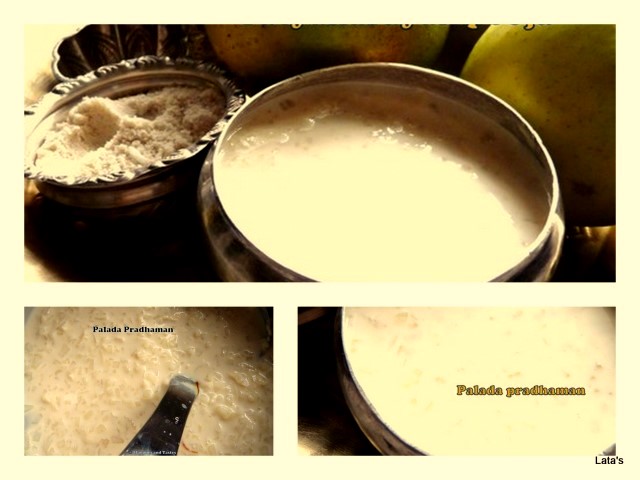
Palada Pradhaman


In an earlier post, easy adai payasam, I had made the payasam using coconut milk. I had learnt to make the palada from a neighbour while I lived in Chennai. Then, my father used to purchase the ready made ada from a shop in Coimbatore and I used them whenever needed. It never crossed me to make some and store at home because I was always making them then for just one time use or was doing with the store bought ada.

Recently Jayasree posted her palada from scratch. That got me enthused to make some ahead and store in my pantry. She has used a vadam stand to make a whole batch of them. As I do not own one such stand I have made them spreading on flat plates like in my earlier post.
I had loads of sunshine in Ghana. Hence sun dried them and stored in a bottle. Now, months on they have kept well in spite of having sat inside a shipment container subject to all weather conditions.
The pradhaman this time was with creamy milk and was made to mark the Thamizh varusha pirappu, the advent of the new calender year.

The demo for making the adas is well illustrated in Jayasree's post. Have a look and then mine if you want to see how to make them even if you did not own a vadam stand :) In my picture you may find the pieces a bit broader, but they shrunk as they dried and are perfect as you see them here presently.


To serve just two I have made with reduced quantity of the ingredients as listed below. Ideally, with 2 litres of whole milk and related ingredients you may well serve six to eight servings.

Ingredients for the paalada: (yield will be about 2/3 rd of a cup of final product)
1 cup Raw rice
Very little salt
2 teaspoons Sugar (totally my idea to make them a bit sweet)
Ghee or oil to grease the plates very lightly

For the pradhaman:
1/4 th cup of ready made palada
750 milk
100 grams sugar


To make the palada:

Wash the rice and soak it in water for an hour. Drain and grind to a smooth paste adding the salt and the sugar. Grind to achieve a batter that is slightly rarer than dosa batter, but not too thin. You should be able to spread the batter in a thin film on a flat plate.

Keep the steamer with sufficient water. Meanwhile prepare a few flat dishes ready by greasing them with drops of cooking oil or ghee.
Pour small ladles-full of the batter on to this and spread evenly over the surface. Steam this for a few minutes one plate at a time. I steamed for around three minutes each. The edge would partly be lifting off by itself around this interval.
Gently remove the cooked ada from the plate. Place the next to steam and so on. you may reuse the same plate over and over until all the batter is done.
Allow the ada to cool. Chop them in small pieces. Spread them over a clean sheet and dry them in the sun. After about four hours turn the ada pieces over, if they have not sufficiently dried. Take care before storing that they are dry, lest you have them growing mould within few days of storing.


This is how the ada looks after drying and this is what we will use in the pradhaman below.

Take about a litre of water in a slightly deep bowl. Bring to a boil and add the ada to the water. Cook them until they are soft.
Meanwhile, in a heavy bottomed deep pan boil the milk. Reduce the heat to the lowest and continue simmering until the milk reduces in volume to 3/4ths of the initial measure.
Drain the water from the ada and add to the simmering milk. Continue to cook further, stirring constantly, until the ada soaks in the milk and the mix is creamy.
Regular stirring is required so that the milk or the mass does not settle to the bottom of the pan and burns.
Add the sugar and continue the cooking until the ingredients blend in a thick creamy mix.


This is a long drawn process, but worth the effort as the pradhaman is a delicious treat.


I am sending this across to Priya's space hosting Nivedita's 'Celebrating sweets event' with Rice sweets.

Thursday, April 7, 2011

Paal payasam


Paal Payasam will top the list of my favourite payasams. Though it is essentially a Palakkad recipe, i remember that it is widely cooked in many a Tamilian household too. I guess everyone who has blogged Palakkad Iyer recipes have shared their recipe of Paal payasam with you.

One of my cousins had given me the following recipe and I share this here. Prior to moving to Malaysia, i used to add all condiments to the payasam. Then a friend told me that they do not add any flavouring additives to the payasam so that the richness and flavour of the milk should be felt wholly.

However additives such as ghee roasted nuts and cardamom powder are added widely.

The below is the mail forward recipe from my cousin.

{Ingredients:

1 liter milk

50 grams raw rice, approximately 1/2 cup (100ml)

1/2 cup (about 120 gms) sugar (Generally the proportion is 1:8 for sugar:milk)

Cook the rice in milk and water. (can be pressure cooked). Once cooked, add the remaining milk and boil till the milk is shortened to 750ml (i.e, by 25%). Add sugar and boil an additional 10 minutes.

Sugar may be added/reduced depending on taste.

This preparation does not need cardamon or cashews but these may be added for flavor.

Will serve 4-8 depending on appetite.

Enjoy!}


I kept the list of ingredients almost to the ratio given in the above recipe. I roasted the washed and drained rice very lightly in a small quantity of ghee prior to cooking it.

So, here is the procedure I followed:

Wash the rice until the water runs clean. Spread on a cloth until the moisture is lost.

Heat 2 teaspoons of ghee in a pan. Add the rice and toss for a few minutes.

Take the rice in a utensil and pressure cook it with some milk and enough water, well until very soft.

Meanwhile in a heavy bottomed deep dish heat the milk. Soon as it boils, reduce the heat and allow to simmer and reduce to about 3/4ths of the initial volume.

Add the cooked rice and allow to simmer until a pink colour is achieved.

Put the sugar in. The sugar will melt and will blend in the simmering milk mixture.

Cook for some more minutes until the payasam thickens a bit and is creamy.

Remove from the stove. If you want you may add cardamom powder and ghee roasted nuts and raisins for garnish.

Serve warm or cold...a very delicious payasam is sure to be a treat.

This payasam is for Priya who is hosting Nivedita's "Celebrate sweets" event with rice sweets, this month.

Thursday, March 3, 2011

Badam Kheer


I am here with yet another post and a resolve to be regular to read posts and to share mine. The past few months (read several) just went in a whirl. Days dawned and before I realised it was nightfall, so to say. Now even before you thought the year began, we have counted out sixty one days of 2011.
Today's post is one rich kheer. Every Indian home makes this if not often, on special occasions. The almonds and whole milk make it truly rich and nutritious for those who do not need to watch calories.
You just need three ingredients apart from garnish and some precious minutes of care while cooking.

The below recipe serves four and is slightly thick. If desired to have as a drink, you make add boiled and cooled milk which has been slightly sweetened to balance the addition.

Ingredients:
Almonds about 80 grams
Sugar 150 grams
Milk 500 ml + 100ml for grinding

Garnish:
Chopped mixed nuts slightly roasted
Few strands of saffron soaked in a few teaspoons of milk

Method:
Bring the milk to boil and allow to simmer for few minutes. Add to this the soaked saffron. Keep aside.
Soak the almonds in warm water for a few minutes and blanche them.
Grind the almonds to a fine paste adding milk. Rinse the jar of the blender and add the residue to the ground mixture.
Add two cups of water to the paste and place it in a heavy bottomed sauce pan. Cook over a moderate flame for about 20-25 minutes stirring at regular intervals, until the paste is rid of raw taste.
Add some of the above boiled milk if the paste thickens in a hurry.
Add the boiled milk and the sugar. Allow the sugar to dissolve and the mixture to blend well.
Remove from the stove. Add the garnish.

It is best served chilled.

Tuesday, September 7, 2010

Parippu pradhaman for Varalakshmi pooja


My never ending quest with Tried and Tasted for the current edition brings you Parippu pradhaman from Aparna. Srivalli is hosting this event, started by Zlamushka to celebrate fellow bloggers, and has been taken over by Lakshmi. The fact is that Valli has chosen the most Diverse Kitchen, for there, you would find everything you might fancy to cook.

My usual payasam for Varalakshmi pooja would have been the undili payasam a quick make up with the ingredients that go into different items on that day's menu. It is done so for convenience and save time. This year, since my husband was away on an official trip and was expected only that evening, I set myself to prepare something more elaborate. So I prepared the parippu pradhaman looking up Aparna's recipe. I have been doing most other things that I am posting this after about a fortnight.


I had prepared the coconut milk beforehand and had powdered the jaggery too as always during festivals. So cooking the pradhaman was not a task, given the hassles of a festival day where you cooked as well as performed the pooja.

The pradhaman was creamy, rich with the coconut flavour and had just the sweetness that you may enjoy. It was the right payasam for that day as we have many other dishes on the menu that will leave you feeling full forever.

My husband reached home ravaneously hungry having skipped breakfast and eaten a meagre lunch. He felt it was such a welcoming bowl of pradhaman.

VERDICT: LIPSMACKING :) I shall pass the compliment on to Aparna.

Monday, August 30, 2010

Thengai-arisi payasam - Coconut and rice porridge


The Friday succeeding the Varalakshmi pooja, we use the coconut and the rice which was used in the kalasam to prepare a sweet dish. I will not be able to use up the entire coconut in one go, unless I make coconut burfis and yet another sweet dish with the rice. This is an impossible feat, considering we are just two members in the family.
I end up cooking a small portion of both in one dish and use the rest in other dishes. This time however, I made coconut burfis and this payasam. The rest of the rice, I used up making sevai.

This payasam is quite easy and delectable. It is usually cooked to a thin and drinkable consistency. It was one of the side dishes for plain rice sevai during my childhood years.On days when my grandparents and mother restricted to themselves to eating salt-free dishes, like Kruthigai vratham or Thiruvonam they make this for a light refreshing kanji. The coconut and rice cooked with jaggery and a dash of cardamom and nutmeg added for flavour make this extremely delicious.

Ingredients: ( Serves two)
3 tablespoons freshly grated coconut
2 tablespoons raw rice
1/4 cup powdered jaggery
1 green cardamom crushed until the pods are coarsely powdered
1 pinch of nutmeg powder

This is how you make the payasam:
Soak the raw rice in some water for about half an hour. Add the coconut to the rice and grind to a very fine paste.
Take this paste in a heavy bottomed pan. Add about 300ml water to it. Cook this mixture over moderate heat stirring often to avoid lumps of cooked rice forming therein.


The rice-coconut mixture will cook and the colour will get slightly tarnished as the mixture thickens. You may add more water if required, though it will not be necessary.
Keep this on a low flame and allow to simmer.
Meanwhile, dissolve jaggery in water and strain the scum. Put the pan on the stove and bring the dissolved jaggery water to boil. Allow to boil until raw taste subsides and the jaggery syrup is slightly thick.
Transfer the jaggery syrup to the cooking coconut-rice mix. Stir and blend them completely.
Allow this to come to boil once and take off the heat.
Garnish with crushed cardamom and nutmeg powder.


Serve warm or cold, it will taste just the same...DELICIOUS!!!


Saturday, June 12, 2010

Whole wheat and Almonds payasam


Given a chance, I have every excuse to stay out of diet plans. This was the case until recently.
I pride myself of not falling sick and enjoy street foods to delicacies provided they are vegetarian.
Then the recent set back was an eye-opener. I had to listen to my body and not abuse it. I decided that I will plan and stick to healthy, yet 'no compromise on taste' food pattern.
Result: I cut down my tea intake, switched to green tea, kanjis/porridges, 'low on oil and spices' dishes.
And I am loving it! Feels good to hear people tell you that you look better :) Combined with a mandatory 40 minute @ 6 km/hr walk on the treadmill is keeping me fit. I have no inclination for the afternoon nap, sleep soundly at night and so on.
I made this kanji powder combining whole wheat, almonds and roasted gram. To add flavour, I ground some cardamom and saffron along with. I have this free of sugar every morning.
Today, I had to make payasam for neivedhyam and quickly fixed this with the ready made powder and full cream milk and of course sugar.
As for the kanji, it takes few minutes to be ready with this powder, dissolved in water to cook and one boil with the milk. However, for the payasam, I let it simmer for a while to bring out the creamy texture and the sugar to blend well.


Ingredients for the powder:
1/2 cup whole wheat
1/4 cup roasted gram
10 numbers almonds
3-4 pieces cardamom whole
Few strands of saffron

Dry roast each separately on a heavy bottomed pan on low to medium heat until well roasted but not very brown or charred.
The saffron should take less than a minute if it is done last and the pan is already very hot.
Combine the roasted ingredients. Allow to cool.
Powder coarsely to fine in a mixie. This filled about 3/4ths of a 450 grams Ovaltine bottle.
The powder stores well at room temperature for about a month.

Add 200ml of water to 2 teaspoons of the powder, bring to a boil, add milk as required. Remove from heat when mixed and Kanji is ready.
Add extra powder and extra milk and sugar as desired for the payasam texture.


Thursday, August 27, 2009

Janmaashtami special Aval Payasam


This is long overdue as many other special recipes for Janmaashtami. We have already celebrated the Ganesh Chathurthi and a Janmaashtami recipe shows up; it is a bit ridiculous. But I was just saving this to send it for few events and so the post got lost among many others. Better late than never, so please bear with this delay and enjoy the payasam.


You will need:
1/4 cup (50 grams) of thick variety aval/poha/ beaten rice
1/2 cup sugar
300ml whole milk
Ghee to roast the aval
Almonds and cashews few soaked and ground to a fine paste
Few strands of saffron
1/4 teaspoon powdered cardamom
A tiny pinch of edible cooking camphor ( Pachchai Karpooram)

Toss the aval in a seive and sift the powdery impurities.
Add ghee in a pan and in warm ghee roast the aval until golden.
Cool and pulse in your mixer just to a very coarse texture. (you may retain aval in whole and cook too)
Cook the aval until soft with water.
Add the sugar and cook further until sugar melts to a syrup and blends with the cooked aval.
Add the paste and the milk and on low heat allow the milk to boil first and simmer. Thus the raw taste of almonds and cashews will also subside.
When done remove from fire and garnish with saffron strands, camphor and cardamom powder.
Offer to Sri Krishna His favourite aval.


The legend is that Krishna's childhood companion Sudhama was struggling to feed his family and upon suggestion from his wife, paid a visit to his friend. He offered aval to Krishna. In return he was blessed with riches and lived happily thereafter.

I shall love to send this aval payasam to Janmaashtami- Ganesh Chathurthi special foods event being hosted by Priti and Purva


and to
FIL - Milk hosted by Sanghi.


Wednesday, August 19, 2009

Phirni


This morning when I walked into my pooja room I saw my big basket filled with fresh flowers. The night security had taken upon himself to collect flowers every morning for my prayers. As appa aptly put it, he deserves to be more blessed for doing this. Though he does this to keep him awake during duty hours, it would be sinful if I wasted them to wilt and die. So I decided to perform the sahasranama. Having decided so, I had to think of quick payasam for offering and ended up whisking Phirni in my microwave. By the time the rest of my everyday cooking was done this was ready too.
Savour the speciality dessert of Kashmir easily cooked in your microwave.


Ingredients:
Whole milk 500 ml
Rice 50 grams
Sugar 100 grams
Cardamom powder 1 teaspoon
Milk cream 1 teaspoon
Saffron few strands
Cashew nuts and slivered almonds few
Ghee few drops

Take milk in a big deep microwave proof bowl. I used a 3.5 litre corningware bowl to boil 500 ml of the milk.
Bring milk to boil by placing in the microwave on 100% power without lid on for 5 minutes.
Wash and soak the rice for 1/2 an hour. Grind to a very fine paste adding little amount of water to it.
In a flat dish, take the nuts and rub the ghee over them. Microwave on 100% power first for one minute and tossing over, again for another minute. The nuts would be crisp and golden now.
In the same deep bowl, mix the rice paste and sugar to the milk. Mix thoroughly well.
Return to the microwave and cook on 60% power, covered for 6 minutes. Every two minutes open, stir and return to cook. See to that the milk does not boil over. If the milk appears to flow out, you can remove the lid.
Once done, add the cream to the kheer, and the saffron strands, reserving few for garnish.
Microwave on 60% power for just 2 minutes longer.
Remove and garnish with strands of saffron and nuts.


Rich and creamy phirni is ready.
Serve chilled.
For a low calorie version use toned milk and avoid cream and nuts, though it is not my recommendation to enjoy this.

I would love to send this to
Sanghi's Fall In Love - Milk event, dedicating this to all kheer lovers
MEC Potluck Party event currently being hosted by Srivalli who initiated the event
and
Shanthi Krishnakumar's State Specials event.This is J&K special dish


Thursday, July 23, 2009

Easy Adai Paayasam


I learnt this from my neighbour, in Chennai. Putting our daughter’s education on top of our list of priorities, I stayed put in Chennai until her primary years of school were done with. We had very friendly and helpful neighbours. This lady was just a few years younger to my mother and showed lot of concern and care, which I appreciate very deeply. She was, then around 60 years of age and doing her M.A. in Sanskrit. She would pass on to me some of what she learnt and had thought relevant. In the same way she would drop tips for my tailoring and culinary skills. One such recipe is this payasam. Though it is very similar to the adai pradaman, I would not dare to name it so, because it is not the same.
Ingredients:
2 tablespoons raw rice
¼ cups powdered jaggery
¼ cups coconut milk
2 cardamons powdered
Wash and soak rice for 20 minutes. Grind to a very fine paste in a blender.
Add water to make a thin liquid, somewhat like milk.
Keep three or four flat steel plates handy, lightly greased.
Put the steamer on stove. Pour the ground batter thinly on one of the prepared plates.
Steam this for a minute and a half.
Meantime, keep one more plate ready. As you remove the first, put this in.
By now, the first adai will be ready to come off the plate. Take it out and keep aside.

Repeat the above steps until all batter is used up.
Cut the cooked batter into thin strips and those into pieces.
Bring some water to boil in another pan. Drop the adai strips in boiling water and continue to boil for a few more minutes.
Mix powdered jaggery with little water. Once dissolved, strain this to remove impurities.
Put back in the pan and let the jaggery boil, add the adai strips and coconut milk.
Taking care not to let the coconut milk over-boil, cook the payasam on low heat and allow the mixture to blend. Add powdered cardamom. Remove from fire and serve as desired.
I would like to send this as my entry to Let's Go Nuts - Coconuts event.